
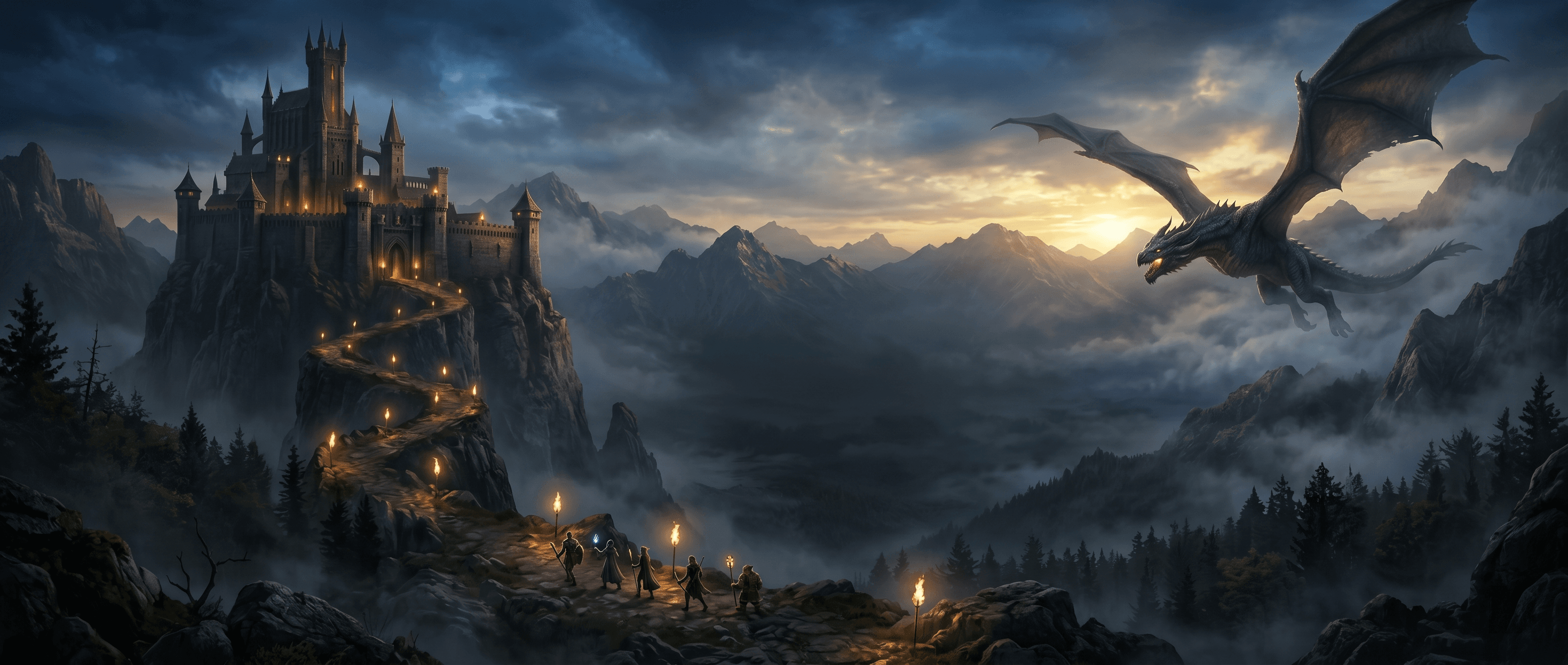
Learn the World of
Dungeons & Dragons
From your first dice roll to your first campaign. Step into a realm of infinite imagination and collaborative storytelling.
Your Journey Begins
Follow the path to master the rules and concepts of Dungeons & Dragons.
What is DnD?
Understanding Dice
Character Creation
Combat Basics
Magic & Spells
Roleplaying
Campaigns
Glossary
Adventure
What is D&D?
Dungeons & Dragons is a game of collaborative storytelling. There is no board to cross, no single way to win, and no limits to your imagination. You and your friends create a story together, guiding your heroes through quests for treasure, battles with deadly foes, and daring rescues.
The Dungeon Master
- ✦The Storyteller: Creates the world, describes what happens, and controls the monsters.
- ✦The Referee: Interprets the rules and decides the outcome of actions based on dice rolls.
- ✦The Host: Plays the role of every other character (NPC) the players meet.
The Players
- ✦The Heroes: Each player controls a single character (their Adventurer) in the world.
- ✦Decision Makers: They decide what their characters say, where they go, and how they fight.
- ✦The Party: Players work together as a team to overcome challenges set by the DM.
The d20 System
Almost every action in Dungeons & Dragons is resolved using a twenty-sided die, known as a d20.
How it works:
- Roll a d20.
- Add any relevant modifiers (like your Strength score).
- Compare the total to a target number (like a monster's Armor Class).
"Roll a 20, and you achieve a Critical Hit. Roll a 1, and disaster may strike."
Test Your Fate
Forging Your Hero
Every adventurer needs an identity. Choose your lineage, your profession, and roll your core attributes.
Human
Versatile and ambitious.
Found everywhere in the multiverse, humans are the most adaptable and ambitious people among the common races.
Racial Traits
- +1 to all Ability Scores
- Extra Language
- Varied Alignments
"I'll see this through, even if it takes a lifetime."
The Flow of Combat
When steel clashes and magic erupts, time slows down into structured rounds. Here is how a typical combat encounter flows.
1. Roll Initiative
2. Take Your Turn
3. Movement
4. Action
5. Reactions
Roll Initiative
Everyone rolls a d20 + Dexterity modifier to determine the turn order.
[ Player (Dex 14) ]: Rolls d20 (15) + 2 = 17.
[ Goblin ]: Rolls d20 (8) + 2 = 10.
Wielding Magic
The weave of magic permeates the world. Learn how to harness it, from simple cantrips to world-altering spells.
Cantrips
Simple, well-practiced spells that can be cast at will without expending any resources. They are your magical bread and butter.
Spell Slots
Think of these as your "mana." Powerful spells require a spell slot to cast. You have a limited number that replenish upon resting.
Concentration
Some ongoing spells require active focus. If you take damage while concentrating, you must roll to see if you drop the spell.
Spellbook Showcase
Fireball
A bright streak flashes from your pointing finger to a point you choose within range and then blossoms with a low roar into an explosion of flame. Each creature in a 20-foot-radius sphere centered on that point must make a Dexterity saving throw. A target takes 8d6 fire damage on a failed save, or half as much damage on a successful one.
Mage Hand
A spectral, floating hand appears at a point you choose within range. The hand lasts for the duration or until you dismiss it as an action. The hand vanishes if it is ever more than 30 feet away from you or if you cast this spell again. You can use your action to control the hand.
Cure Wounds
A creature you touch regains a number of hit points equal to 1d8 + your spellcasting ability modifier. This spell has no effect on undead or constructs.
Shield
An invisible barrier of magical force appears and protects you. Until the start of your next turn, you have a +5 bonus to AC, including against the triggering attack, and you take no damage from magic missile.
The Art of Roleplaying
Not every problem requires a sword. Interacting with the world and its inhabitants is often the most memorable part of the game.
Speaking in Character
You can act out your character's voice and mannerisms, or simply describe what they do. Both are perfectly valid ways to play!
First-person: "I slam my tankard on the table and demand to know where the goblin camp is!"
Third-person: "My character, Grom, slams his tankard on the table and intimidates the barkeep."
Character Motivation
Your character isn't just a set of stats. Think about their:
- Ideals: What drives them? (e.g., Justice, Greed)
- Bonds: Who or what do they care about?
- Flaws: What is their weakness? (e.g., Easily angered)
Interactive Scenario
"You enter a dusty shop. Behind the counter, a suspicious merchant with a scarred eye eyes you nervously. 'Got some rare goods, I do. No refunds,' he mutters."
How do you respond?
The Adventure Structure
How is a game of D&D actually organized? From a single night of play to an epic multi-year saga.
The Campaign
The overarching story. Like a TV show series, a campaign connects all your adventures together. It can last for months or even years, tracking your characters from level 1 to god-like power.
The Session
Like a single episode of a TV show. This is one sitting of play, usually lasting 3-4 hours, where you gather around the table (or virtually) with your friends.
Quests
Specific objectives within the campaign. Slaying a dragon, rescuing a captive, or retrieving a stolen artifact.
NPCs
Non-Player Characters. The merchants, kings, villains, and bystanders controlled by the Dungeon Master that flesh out the world.
Arcane Glossary
A quick reference for the common terminology you will hear at the table.
Your First Adventure
Experience a tiny slice of D&D. Read the Dungeon Master's description and make your choice.
"You stand before the gaping maw of the Whispering Cave. The air smells damp, and a faint, unnatural green glow pulses from deep within. A battered wooden sign reads: 'Danger - Goblins.'"